

news
Green Matters: Composting Strategies for Floral Shops
July 7, 2025
Green waste in the floral industry is inevitable. Stem trimmings, petals, and withering blooms unfit for sale are part of everyday business as owners create stunning arrangements for customers.
Because these byproducts are destined to become decomposed organic waste, composting is a strategy that helps keep harmful emissions from the environment. For mid-size floral shop owners, however, composting programs may present some challenges – space, cost, time and odor.
To help shop owners address those hurdles, Sustainabloom’s Industry Guide on Composting offers a practical framework tailored to the floral industry. Developed by top researchers, the guide breaks down the composting process, outlines on-site and off-site options, and offers tips to implement and improve sustainable waste management over time.
Equipped with this research-backed guide and additional tools available on Sustainabloom’s website, floral businesses now have a more accessible path toward launching—and benefiting from—composting programs that work for their unique operations.
Small Spaces Make Big Impacts
Lack of space has long been a top concern for floral shop owners looking to compost. But Betsy Gardner, owner of The Plant Shoppe Florist in Gainesville, Florida, said even a small space outside of the business can work for composting.
Gardner began composting in 2002, using a green space behind her shop. But a move to a new location in a shopping area would present her first challenge—the loss of available space to compost.
She said she didn’t want to add the extra expense of having the city take away the waste, so she set out to find others who may benefit from it in their own composting efforts. Some, she admitted, were hesitant to accept the waste without verification of its contents.
“So, I started bringing it to my house,” she said. “We don’t use it on vegetable or fruit crops, but we now have it for use in our landscaping.”
With an acre of ground, Gardner said any odor from decomposing organic matter isn’t an issue.
Returns on Investment
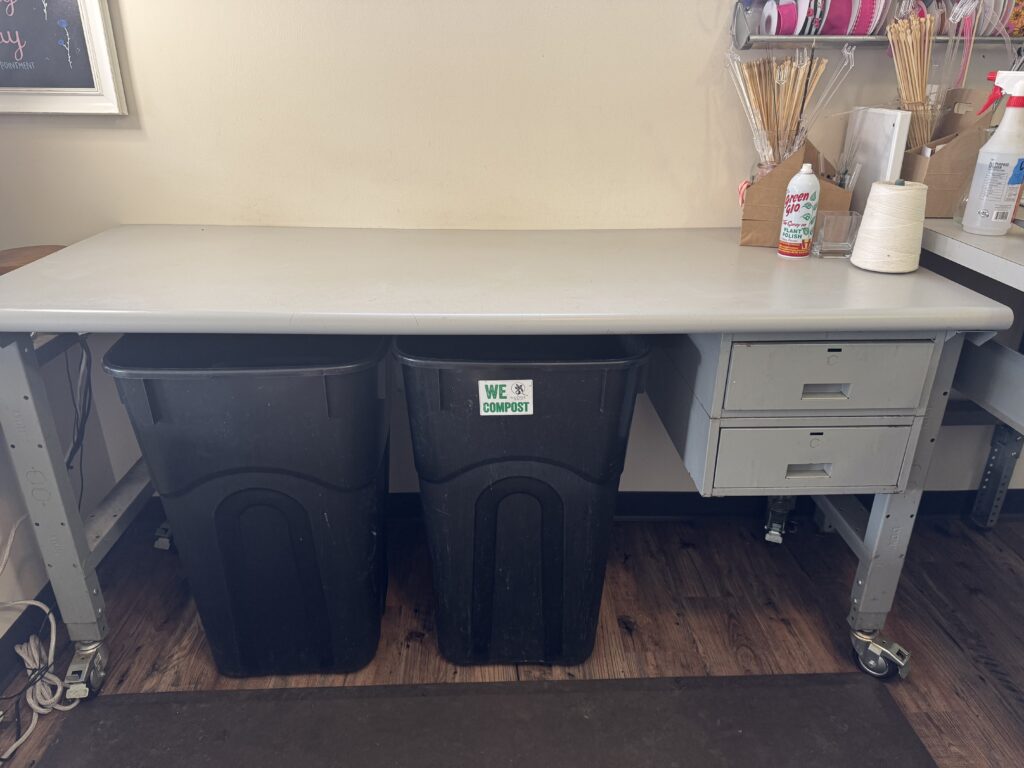
Vanessa O’Brien, owner of Bloom Wichita in Wichita, Kansas, has had a composting strategy in place since she opened her shop in 2020. In those five years, O’Brien said she works with a local composting company, which primarily handles residential and commercial green waste, collecting stems and plant materials weekly. In that time, 10 tons of organic waste from the shop were turned into 6,500 pounds of finished compost for use in landscaping and other projects.
O’Brien said she pays around $80 each month, a cost she is willing to incur to have green waste hauled from her business. Each design table in the shop is equipped with two bins, one for trash and the other for green waste, which is transferred daily into two lidded trash cans in the garage area, where it is picked up weekly.
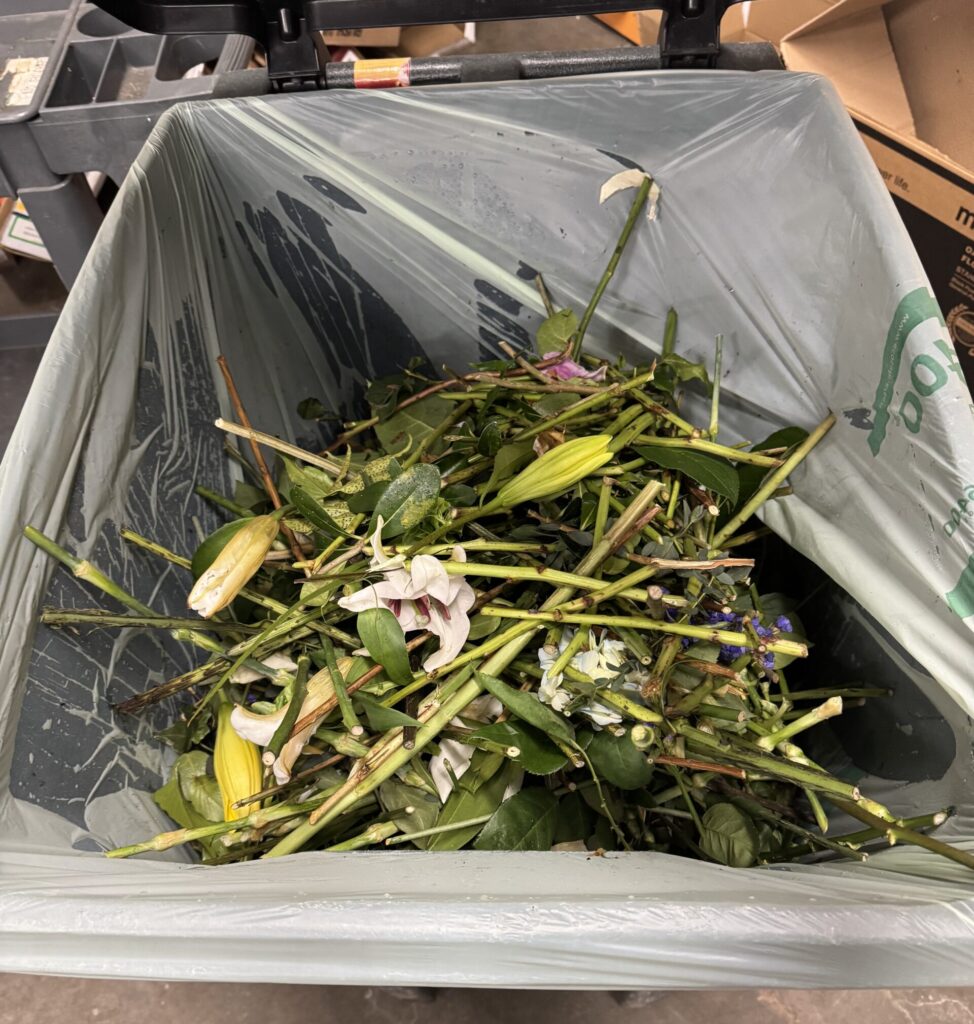
O’Brien said that in addition to the added value to the environment, working with a local company helps support other businesses at a very low cost to her shop. She said composting has also helped her save money in other areas.
“Shop owners that are composting their green waste can see savings through the need for smaller trash dumpsters because there is so little to throw away,” she said.
For those composting their own waste, Gardner noted that shop owners can generate additional revenue by using the free material in other areas of business, including plant-your-own-garden packages or selling to nearby garden centers.
Boosting Composting Strategies
Gardner said her composting efforts are made more effective with other sustainability initiatives in place. That begins as soon as the flowers arrive at the shop. Plastic and cardboard wrappers are recycled, and the rubber bands removed from the bundles of flowers are donated to area organizations, including the Girl Scouts, for use in their various projects.
“We collect green matter, including stems, flowers, even apple cores and banana peels from lunch, daily in a bin here at the shop. Then I can easily take that bin to my house and add it to the compost pile,” she said. “I have even donated some of the compost to school organizations and the scouts for compost needs to fill in their landscaping projects.”
Her green waste management philosophy is to start with creating as little waste as possible in the first place. She returns boxes back to suppliers, donates the straws from Gerber daisies to schools, and helps a local ceramic shop owner out with bubble wrap for packaging purchases.
O’Brien said she is also mindful of the amount of waste the shop produces overall, recycling and reusing materials, as well as sourcing locally whenever possible. The shop offers a glass recycling program and reuses water in flower beds.
“What I have found is that everyone wants to do something good for the environment. Everyone is open to it,” said O’Brien. “With just a couple of extra trash cans, composting is a way to do that, and it’s not difficult.”
Ready to Get Started?
Whether you’re a small floral studio or a larger shop, composting doesn’t have to be complicated—or costly. Check out Sustainabloom’s Industry Guide on Composting to explore composting systems that fit your space, budget, and business goals. You’ll find implementation strategies, ROI tips, benefits of composting, and additional resources to help you take the next step in managing your green waste more sustainably.


